
And just like that, 2025 draws to a close. Let’s take a quick look at just how far the industry has come this year:
- Around 584.1 million people across the globe listened to podcasts in 2025.
- The total number of American monthly podcast listeners has grown by 7% this year, currently sitting at 55%.
- 40% of the adults in the United States listen to podcasts weekly, up 6% from 2024.
- 1/3 of people in the U.S. listen to podcasts on YouTube, making it the most popular platform for podcasts.
- In 2015, just 10% of brands planned to advertise in podcasts. By June 2025, the intention to invest in podcast advertising has jumped to 69%, a sevenfold increase.
- 75% of listeners agreed that branded podcast episodes keep their attention for the entire time.
- 51% of marketers have adopted podcasts in their marketing strategy, with 53% of them stating that podcasts are the most effective form of content marketing.
With all that said, it’s safe to say that the industry made big strides this year, but now it’s time to look at the year ahead.
We got the chance to pick the brains of some of the best people in podcasting and ask them:
- Looking ahead to 2026, what’s your biggest prediction for the podcast industry? What do you think will define the next chapter of podcasting and why?
- Do you have any tips or advice for brands and creators in 2026 when it comes to podcasting?
Here’s what they had to say:
Podcast predictions for 2026
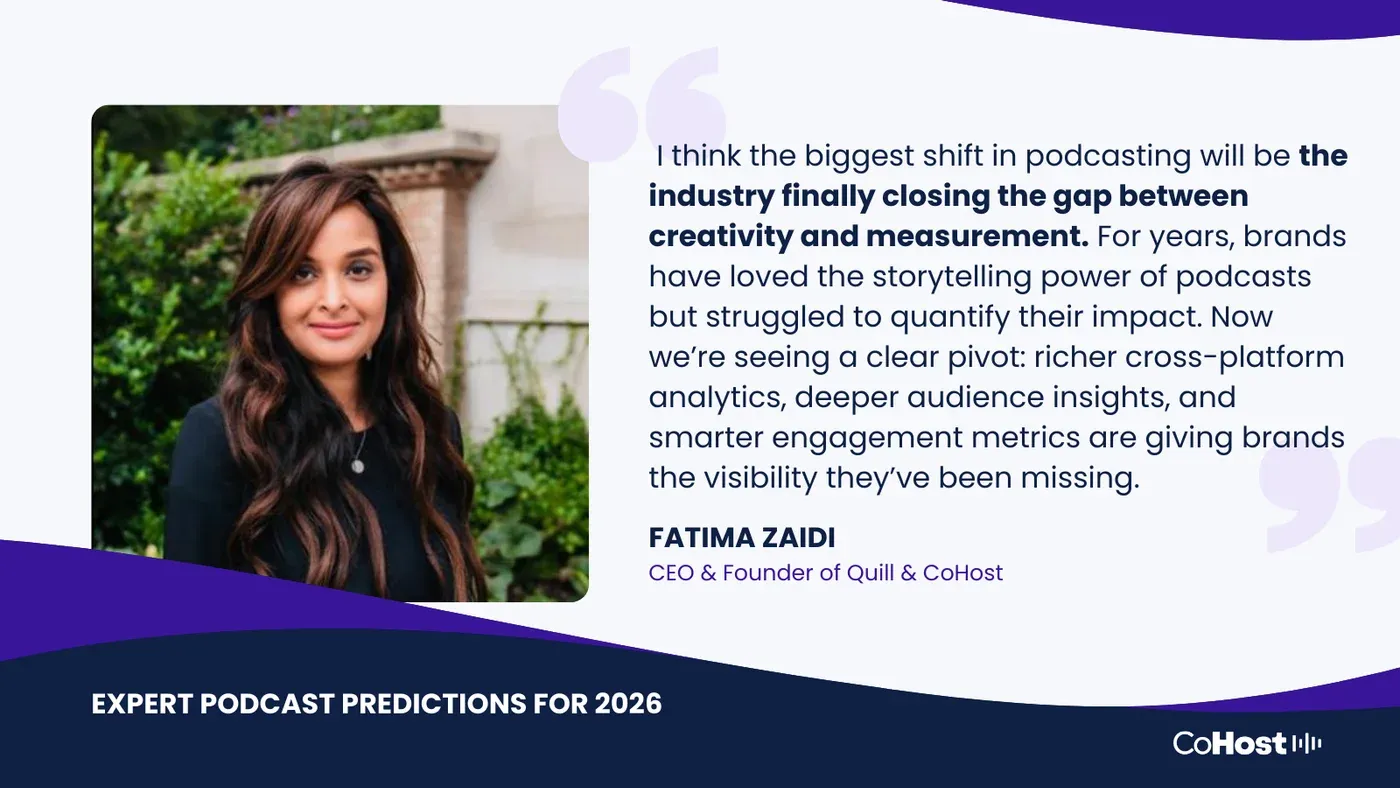
“The industry will finally close the gap between creativity and measurement.”
“Looking ahead to 2026, I think the biggest shift in podcasting will be the industry finally closing the gap between creativity and measurement. For years, brands have loved the storytelling power of podcasts but struggled to quantify their impact. Now we’re seeing a clear pivot: richer cross-platform analytics, deeper audience insights, and smarter engagement metrics are giving brands the visibility they’ve been missing.
As this becomes the norm, the brands that win won’t just produce great content, they’ll use data to shape it. They’ll build episodes around what their audience actually listens to, track which channels drive real listeners, and measure success with metrics that go far beyond downloads - like consumption and cost per listener attention.
Ultimately, in 2026, executives will finally get the ROI story they’ve been asking for and have the tools to create more impactful podcasts backed by data, not assumptions.”
Fatima Zaidi, Founder and CEO of Quill and CoHost
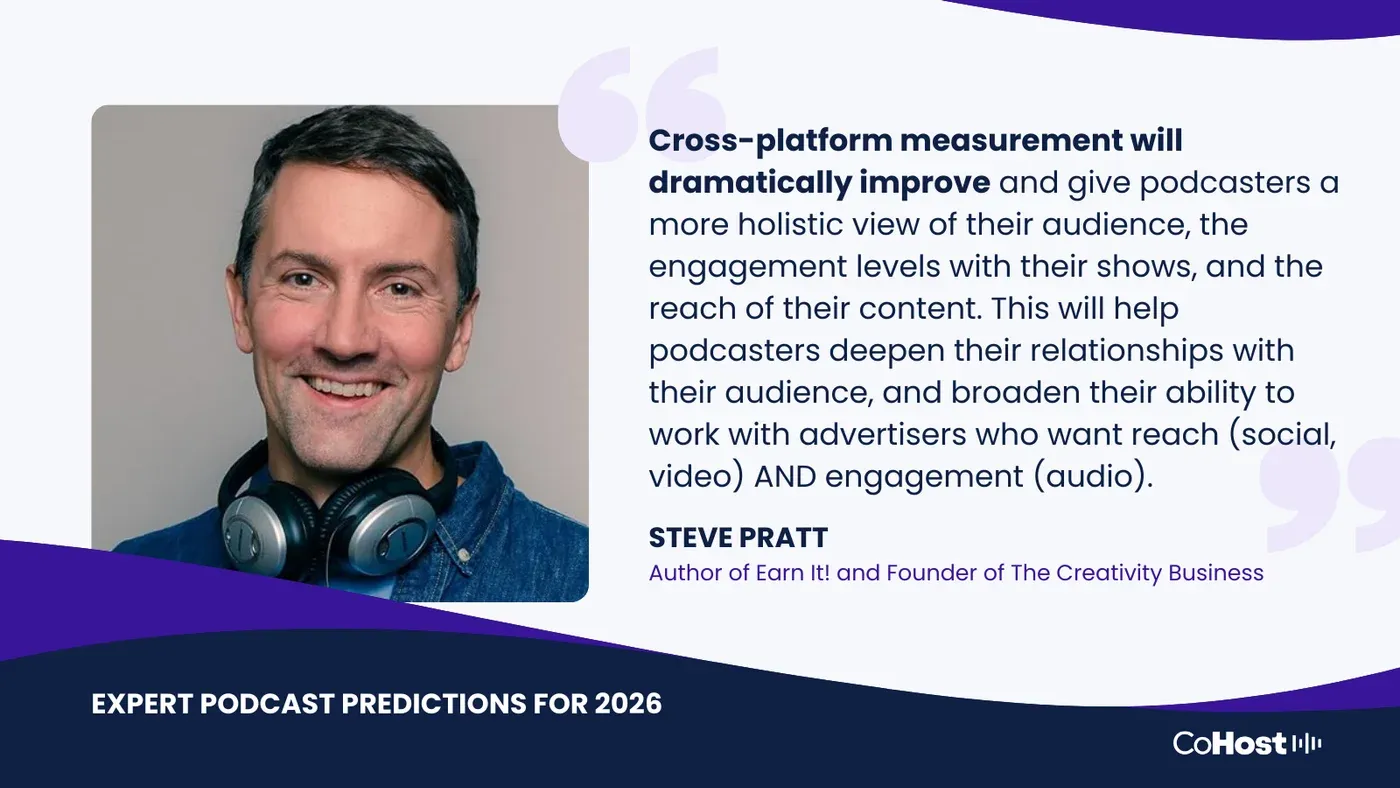
“Cross-platform measurement will dramatically improve and give podcasters a more holistic view of their audience.”
“Cross-platform measurement will dramatically improve and give podcasters a more holistic view of their audience, the engagement levels with their shows, and the reach of their content. This will help podcasters deepen their relationships with their audience, and broaden their ability to work with advertisers who want reach (social, video) AND engagement (audio). It will also encourage more podcasters to adopt a multi-platform strategy and mindset.”
Steve Pratt, Author of Earn It! and Founder of The Creativity Business
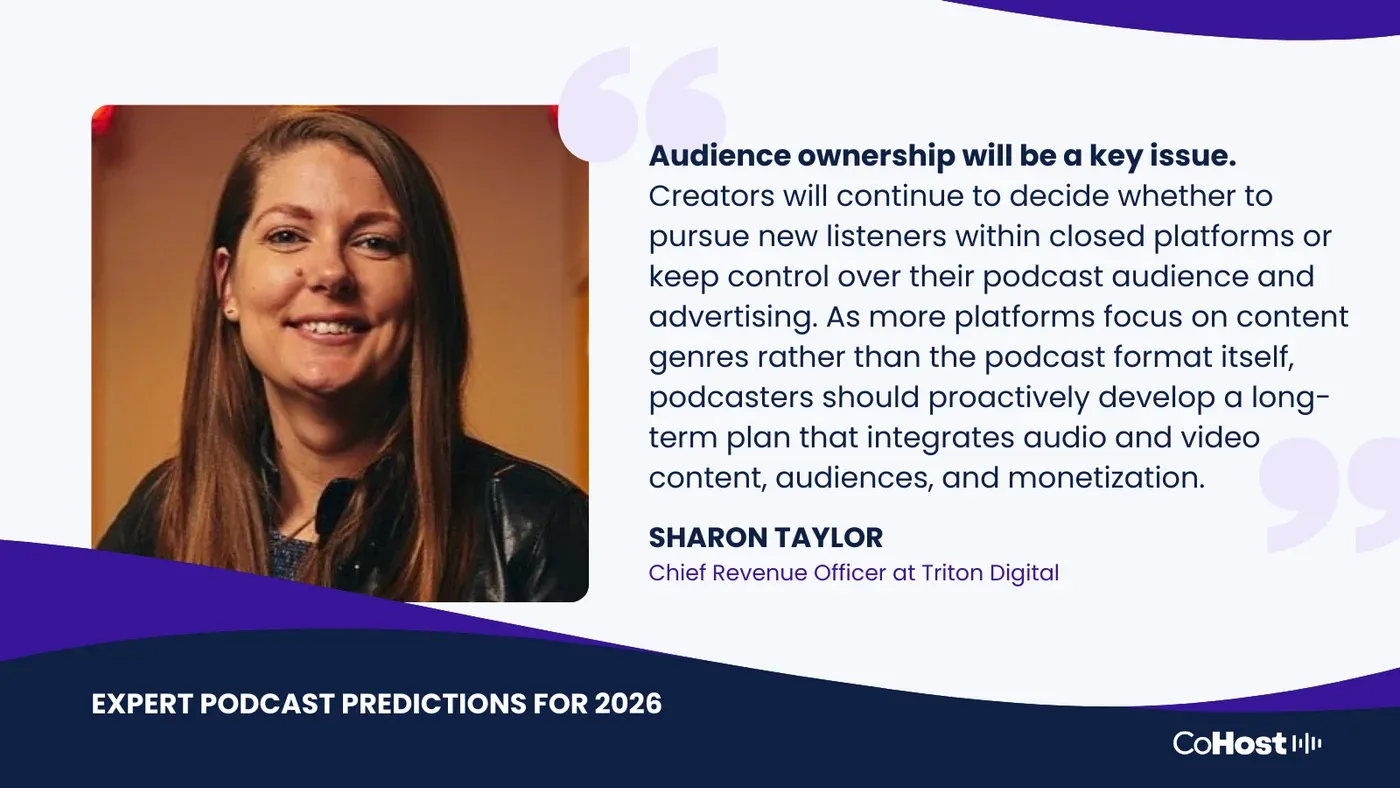
“Audience ownership will be a key issue.”
“In 2026, audience ownership will be a key issue. Creators will continue to decide whether to pursue new listeners within closed platforms or keep control over their podcast audience and advertising. As more platforms focus on content genres rather than the podcast format itself, podcasters should proactively develop a long-term plan that integrates audio and video content, audiences, and monetization. Taking steps to align strategies and remembering the distinct advantages of audio, instead of treating these elements as separate parts of the business, will be foundational to podcasting’s continued growth.”
Sharon Taylor, Chief Revenue Officer, Triton Digital
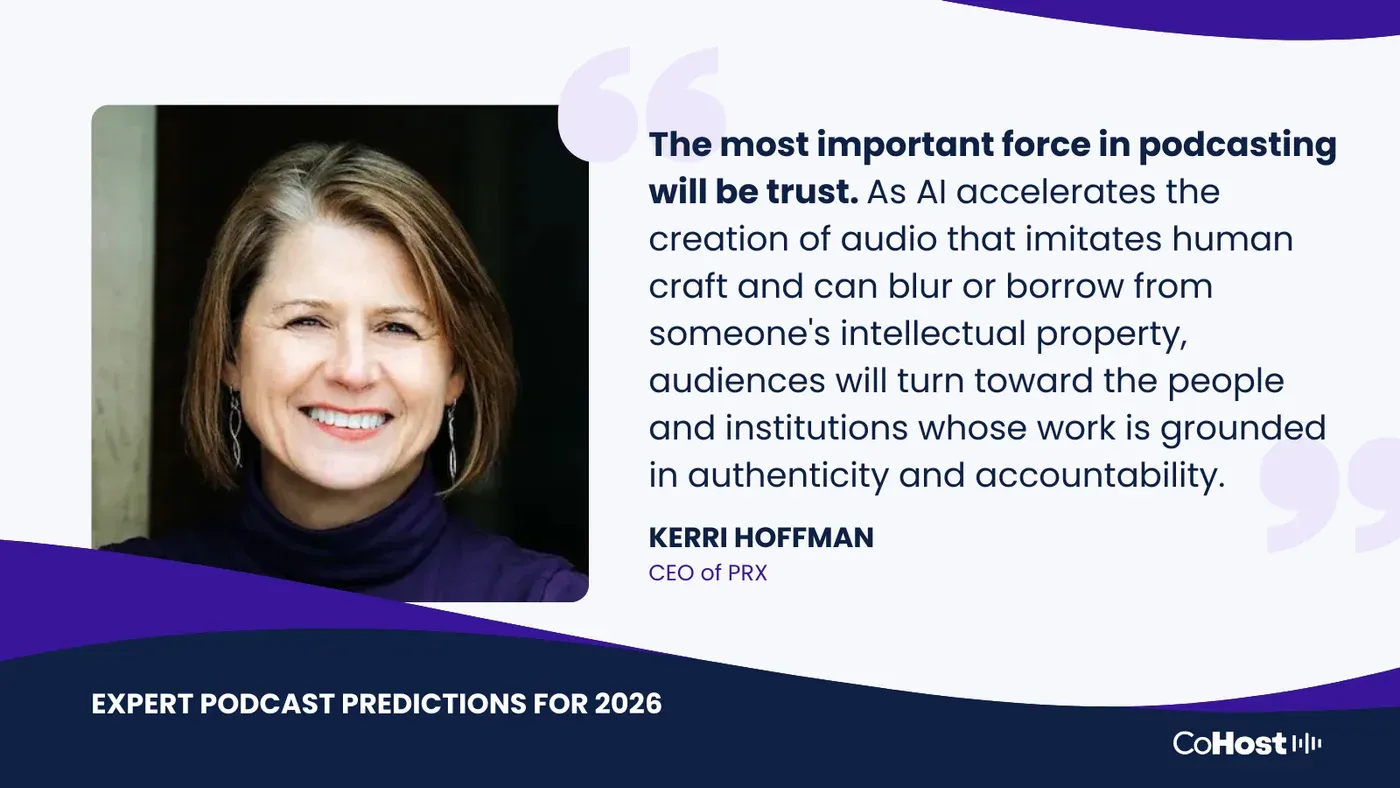
“The most important force in podcasting will be trust.”
“In 2026, the most important force in podcasting will be trust. As AI accelerates the creation of audio that imitates human craft and can blur or borrow from someone’s intellectual property, audiences will turn toward the people and institutions whose work is grounded in authenticity and accountability. Our strength - as a system and a creative community - has always been human storytelling rooted in real places, real reporting, and real imagination.
In an era when anything can be generated, the value of human connection - a host who guides you, a reporter who knows your community, a creator sharing something remarkable and insightful - becomes irreplaceable. The future of podcasting will belong to those who create with purpose and build connection.”
Kerri Hoffman, CEO, PRX
“A shift in the distinction between the podcast industry and the advertising industry.”
“I think there is going to be a shift in the distinction between the podcast industry and the advertising industry. While the ad tech giants have found a home in programmatic ads, the smoke and mirrors is just that. There’s an overdue move back to quality over quantity, and production houses with real talent will see a shift in how they survive while the ad agencies eat themselves alive. The idea of AI hosts and generated content is flawed; people are already disgusted with AI slop. It’s offensive at best, and consumers aren’t stupid, they’re overwhelmed with consumerism. The Gary V model of more-is-more is dead.
The days of the suits claiming they are “charting the course for the future of audio” are dwindling fast. They’ve never touched an audio file but somehow think they’re leading the charge? We’re heading back into pandemic-era vibes with in-person events, and people are sick of being sold to while creatives can barely pay their rent. They’re so busy raking in millions for newsletters they didn’t notice all the pockets they took it from, but we did. Meanwhile, high-quality content, the stuff people look forward to, content that feels like a warm hug, is finally coming back into focus. Brands will embrace podcasts for relationship building and turn away from thought leadership because the ROI is clearer and downloads never mattered.
On the flipside, podcasts are going to dominate mainstream media because they aren’t handcuffed by the big outlets. But that content shouldn’t be confused with podcasts produced for a purpose beyond news. The Joe Rogans of the world are the catalyst for new-world media, and it’s only the beginning. This morning, the world learned that half of Rogan’s followers are bots and the media’s touch is crushing his downloads without any help from the advertising grifters claiming to be in the podcast industry. Is MediaTouch running programmatic ads? No. There’s your answer.
We need to get the ad industry out of our spaces and keep the tech companies at bay. Solo podcasters might benefit from tools like Riverside, but that doesn’t mean they have value for large production houses. When a company doing $10M a year charges real production teams $1,800 a month for a virtual studio full of tools we’ll never use, it’s a cash grab. The disconnect between the actual podcast community and the tech and ad agencies is wider than the Grand Canyon. Creative agencies are shuttering while tech bros gobble everything up, and the people making the content can’t pay their rent.
Let’s pay creatives what they’re worth.
Let’s focus on relationships.
Let’s stop feeding the machine.”
Molly Ruland, CEO & Founder, Heartcast Media
“We’re entering an era where ‘pull’ mechanisms, search and algorithmic suggestions, will work alongside traditional push strategies.”
“For years, podcast growth has been primarily a ‘push’ game, you grow by leveraging your existing audience, social media, or guest swaps. But listener behavior is shifting. Today, nearly 50% of listeners search for new shows directly within their listening app, and platforms like YouTube, Spotify, and Apple have become primary discovery channels with their own search dynamics.
We’re entering an era where “pull” mechanisms, search and algorithmic suggestions, will work alongside traditional push strategies. Listeners are increasingly discovering podcasts the way they discover videos or articles, while still relying on trusted recommendations.
This means Podcast SEO (or what we call Podcast Search Optimization (PSO) at Ausha) will become a core skill, not a nice-to-have. Optimizing titles, descriptions, episode keywords, and metadata will directly impact your reach. The podcasters who master both push and pull strategies early will have a massive competitive advantage.
And I think this will be especially transformative for B2B podcasts. Companies are realizing that podcasting is one of the most powerful tools for thought leadership, new business, and audience nurturing, but ROI has always been hard to prove. When discoverability improves, B2B shows will finally be able to attract inbound listeners beyond their existing network.”
Maxime Piquette, CEO, Ausha
“The industry will be defined by a few large, durable franchises rather than an endless field of one-off shows.”
“My prediction for the podcast industry in 2026 is that it will be defined by a few large, durable franchises rather than an endless field of one-off shows. Listeners will commit to a smaller number of trusted franchises and/or hosts, and the hits will feel less like disconnected episodes and more like ongoing story worlds that evolve over time.
We’ll also get smarter about how and where those podcasts show up. Growth will come from making podcasts easier to find and experience in different contexts, not from forcing every series into every format. Video will be used when it truly enhances the storytelling or deepens the connection with a particular audience, while plenty of successful shows will remain audio-first. In 2026, the strongest franchises will be the ones that move between formats only when it serves the listener, rather than trying to check every box by default.”
Ainsley Rossitto, Senior Director, Podcast Strategy & Operations, Paramount
“The possibility of seeing more funding opportunities for Canadian creators in 2026.”
“I love to keep an eye on the state of podcasting in Canada, especially for independents. I have my eye on the possibility of seeing more funding opportunities for Canadian creators in 2026.
In 2025, nearly 100 Canadian podcast professionals signed an open letter to the federal government calling for funding to support the country’s ecosystem of podcasters. At the same time, the year was chock-full of conversations debunking the measurement of downloads, highlighting that many Canadian podcasts are likely more valuable to advertisers than they’d originally thought due to their highly engaged audiences.
I hope and believe that by the end of 2026, we’ll see many independent Canadian podcasters bringing in more revenue from advertisers and producing higher-quality content, also thanks in part to grant funding. For this reason, we may see more indie shows, including video production and experimenting with more creative and production-heavy series.”
Kattie Laur, Principal & Executive Producer, Pod The North
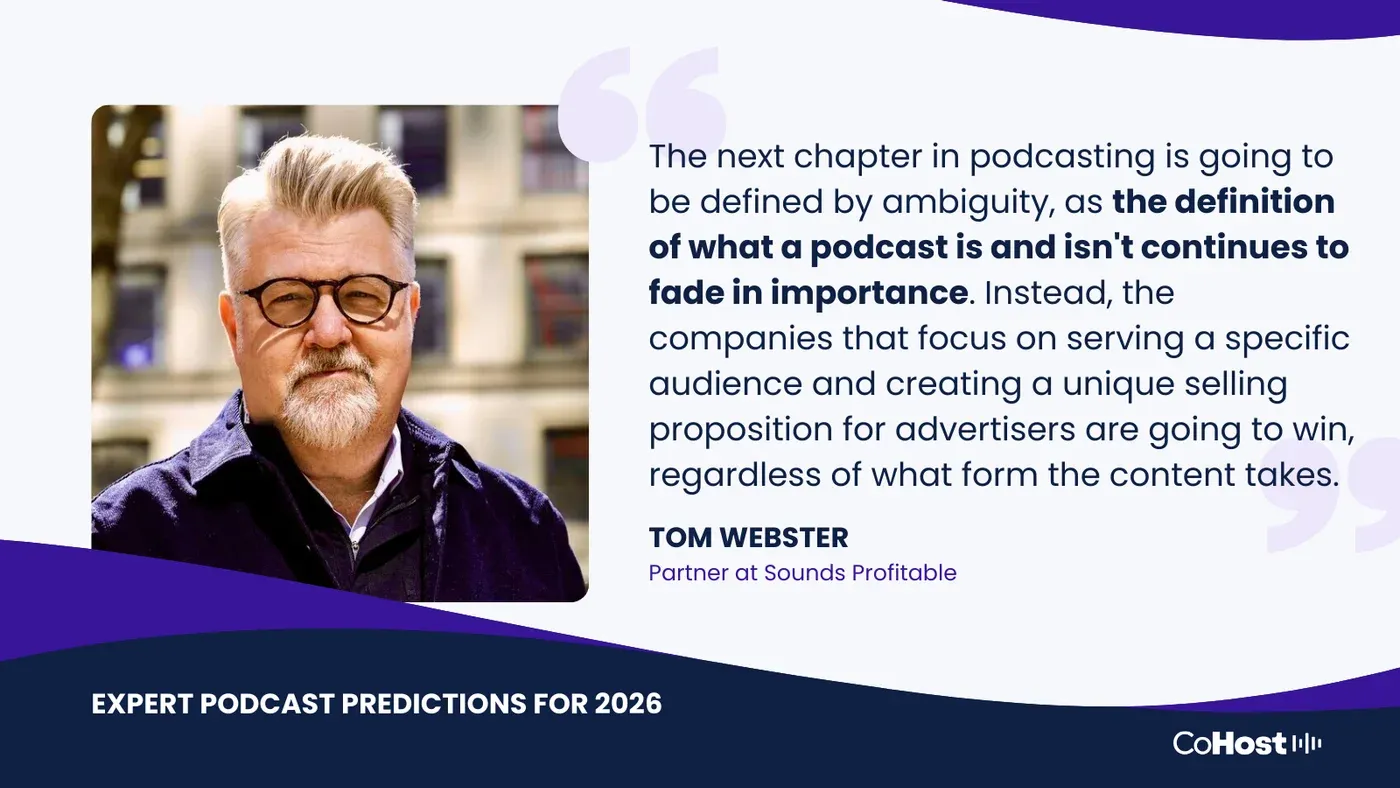
“The definition of what a podcast is and isn’t continues to fade in importance.”
“The next chapter in podcasting is going to be defined by ambiguity, as the definition of what a podcast is and isn’t continues to fade in importance. Instead, the companies that focus on serving a specific audience and creating a unique selling proposition for advertisers are going to win, regardless of what form the content takes.”
Tom Webster, Partner, Sounds Profitable
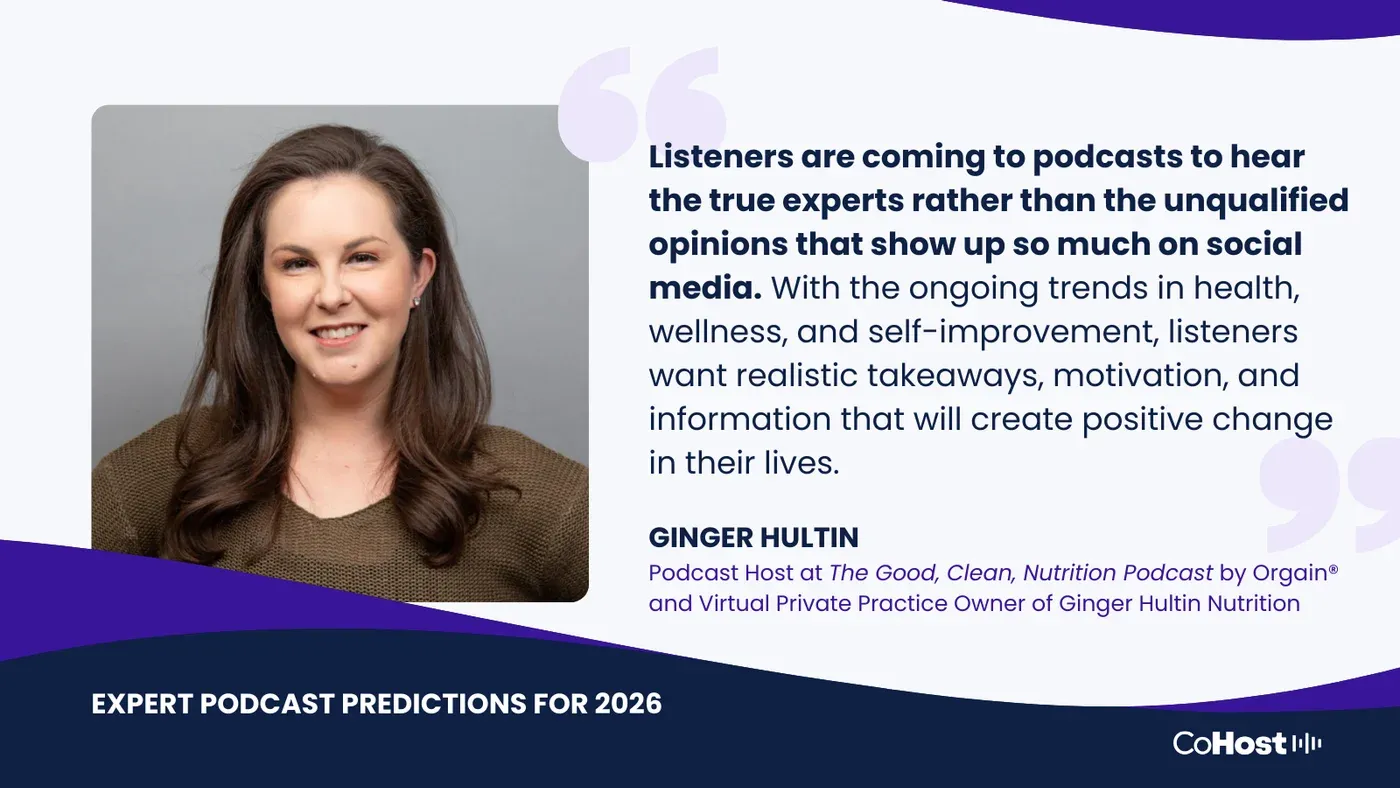
“Listeners are getting more and more savvy.”
“Listeners are getting more and more savvy - they’re coming to podcasts to hear the true experts rather than the unqualified opinions that show up so much on social media. With the ongoing trends in health, wellness, and self-improvement, listeners want realistic takeaways, motivation, and information that will create positive change in their lives. Positivity and entertainment also prevail as listeners engage on their commutes, walks, or even while cleaning their house or running errands.”
Ginger Hultin, Podcast Host at The Good, Clean, Nutrition Podcast by Orgain® and Virtual Private Practice Owner of Ginger Hultin Nutrition
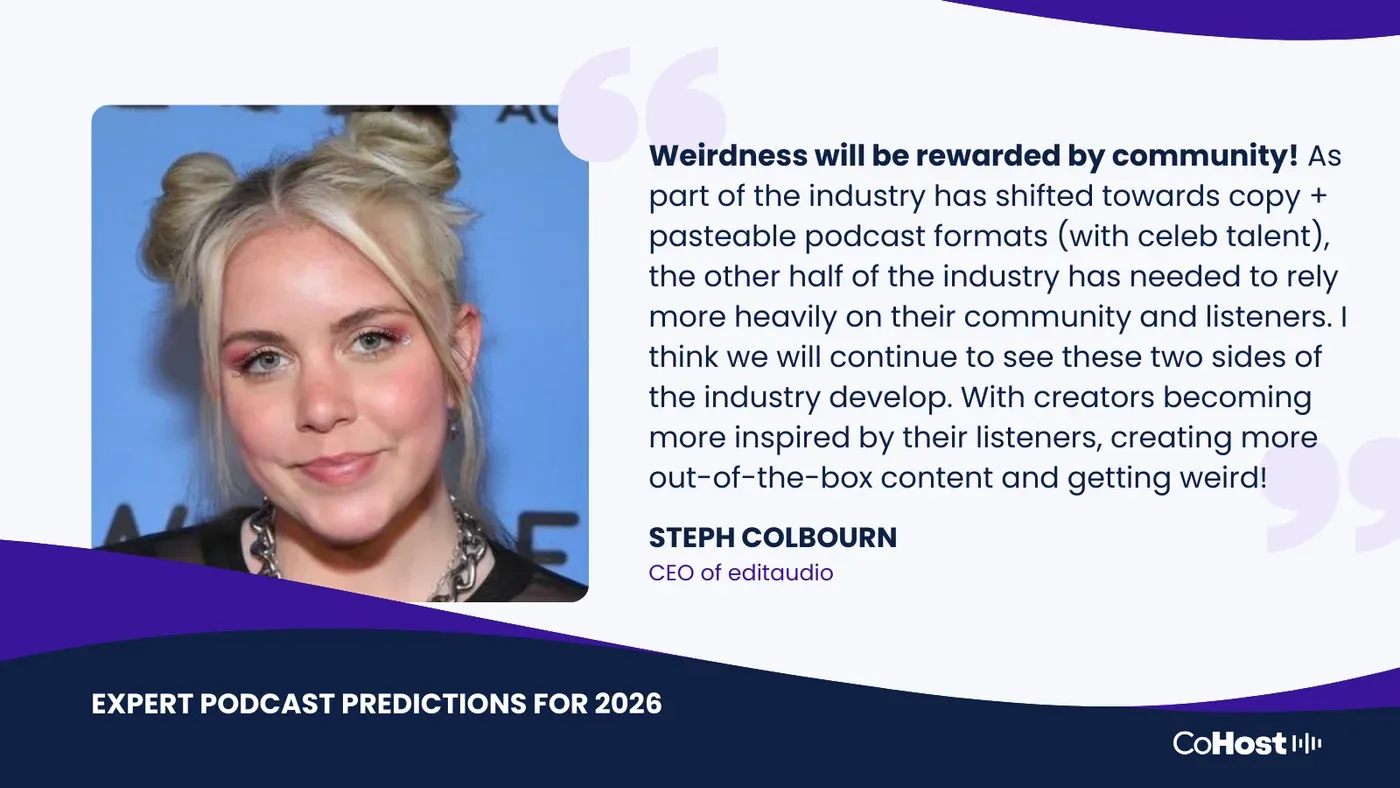
“Weirdness will be rewarded by the community.”
“Weirdness will be rewarded by the community! As part of the industry has shifted towards copy + pasteable podcast formats (with celeb talent), the other half of the industry has needed to rely more heavily on their community and listeners. I think we will continue to see these two sides of the industry develop. With creators becoming more inspired by their listeners, creating more out-of-the-box content, and getting weird!”
Steph Colbourn, CEO, editaudio
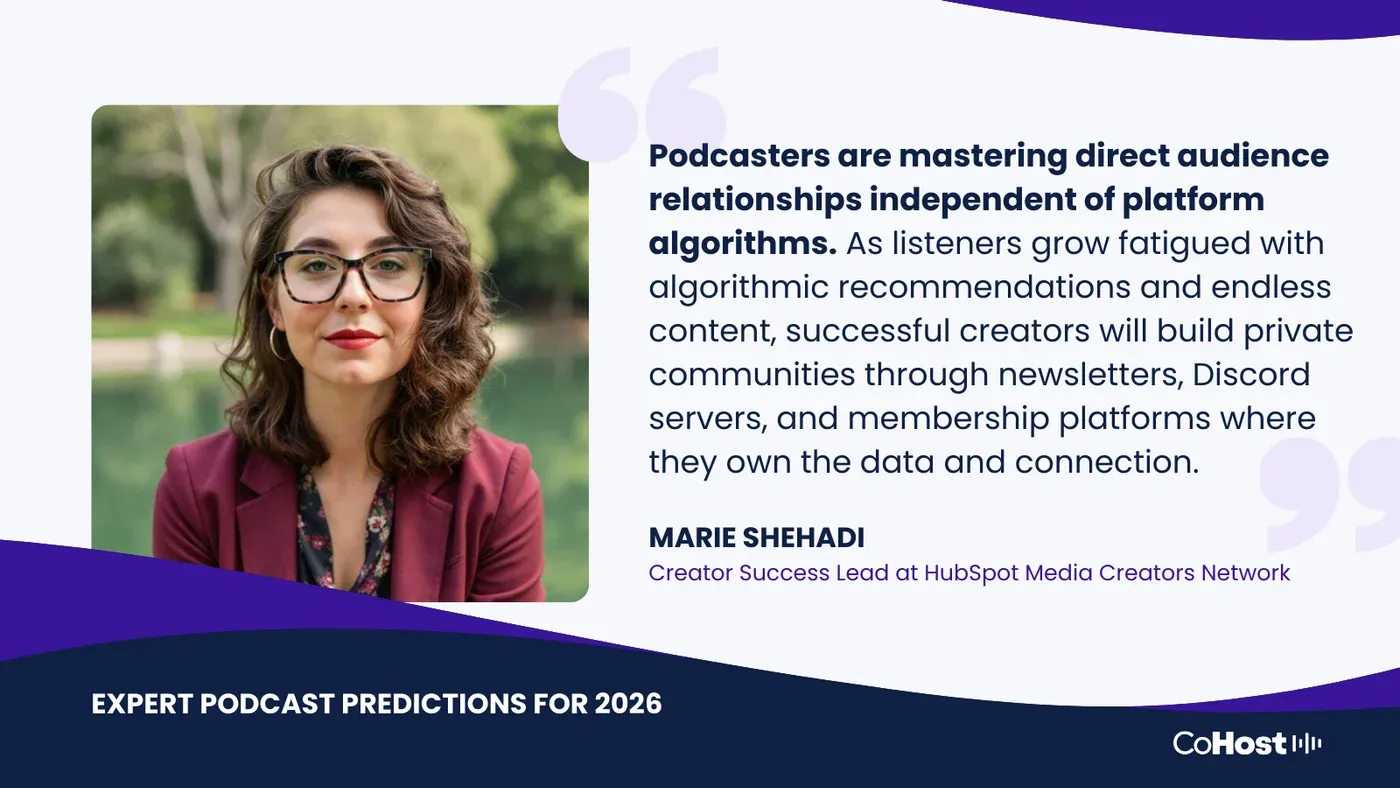
“Podcasters are finally mastering direct audience relationships independent of platform algorithms.”
“The biggest shift in 2026 will be podcasters finally mastering direct audience relationships independent of platform algorithms. As listeners grow fatigued with algorithmic recommendations and endless content, successful creators will build private communities through newsletters, Discord servers, and membership platforms where they own the data and connection. This represents a counter-movement to platform dependency, where a smaller, more engaged audience becomes more valuable than massive but passive listener numbers. A double monetary value to come out of this as Influencer Marketing continues to dominate larger company marketing strategies, and podcasters can solidify their direct-to-creator payment funnel.”
Marie Shehadi, Creator Success Lead, HubSpot Media Creators Network
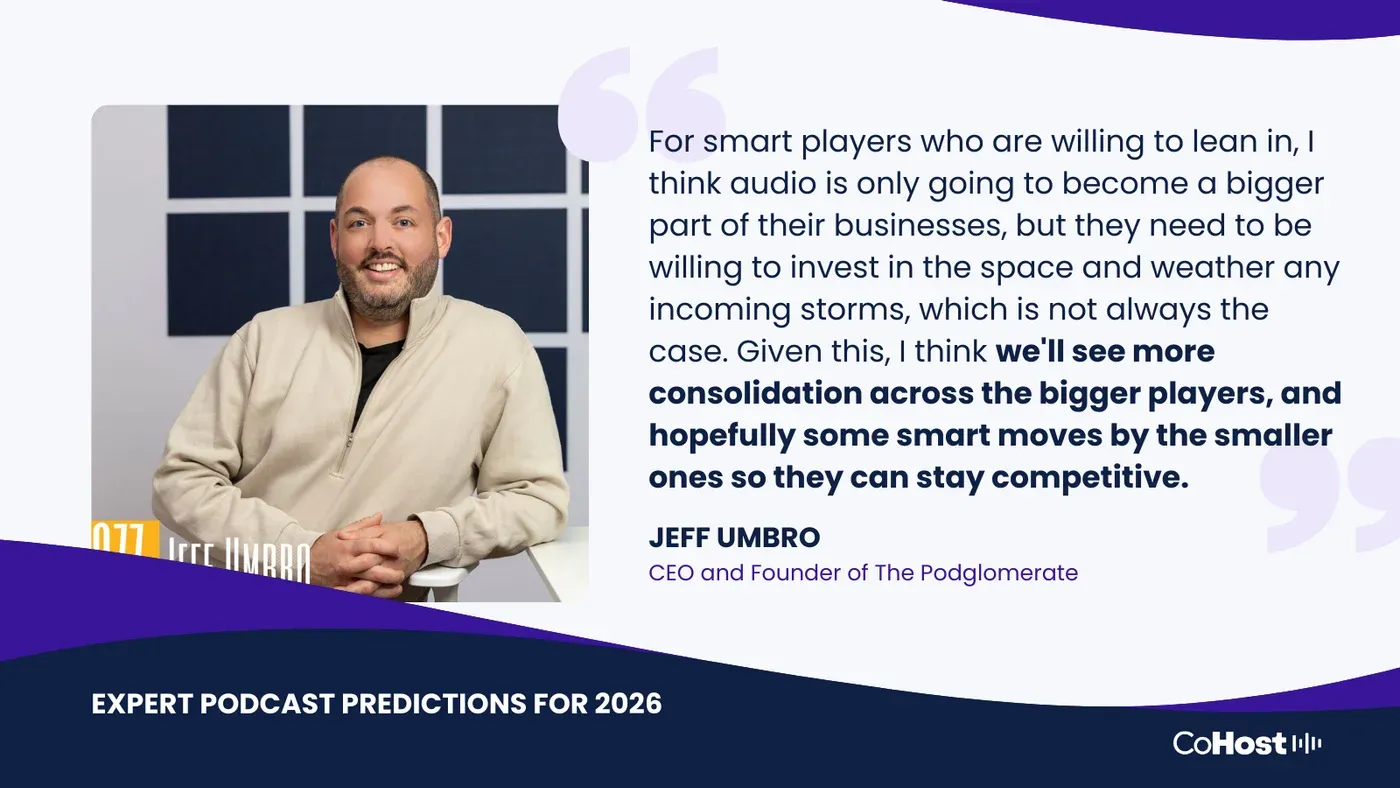
“The bigger players continue to get bigger but are also rethinking their own business strategies around audio.”
“We’re at an interesting inflection point for the industry, where the bigger players continue to get bigger but are also rethinking their own business strategies around audio. Some folks are doubling down and reinvesting in the space, whereas others are trying to get as lean as possible to finally become profitable (or more profitable).
For smart players who are willing to lean in, I think audio is only going to become a bigger part of their businesses, but they need to be willing to invest in the space and weather any incoming storms, which is not always the case. Given this, I think we’ll see more consolidation across the bigger players, and hopefully some smart moves by the smaller ones so they can stay competitive.
Specifically, I think we’ll see some folks lean into more operationalized vehicles (i.e., a lot more programmatic ads), invest more in video (either licensing shows for ads or leaning into video production as another revenue source), and do less of the things they’ve seen not working (which unfortunately probably means less narrative shows).
A bright spot: with NPR stations struggling with their revenue constraints in the wake of the CPB defunding, I think a lot of amazingly talented stations will focus more on partnerships that make sense for them, which I think is long overdue.”
Jeff Umbro, CEO and Founder, The Podglomerate
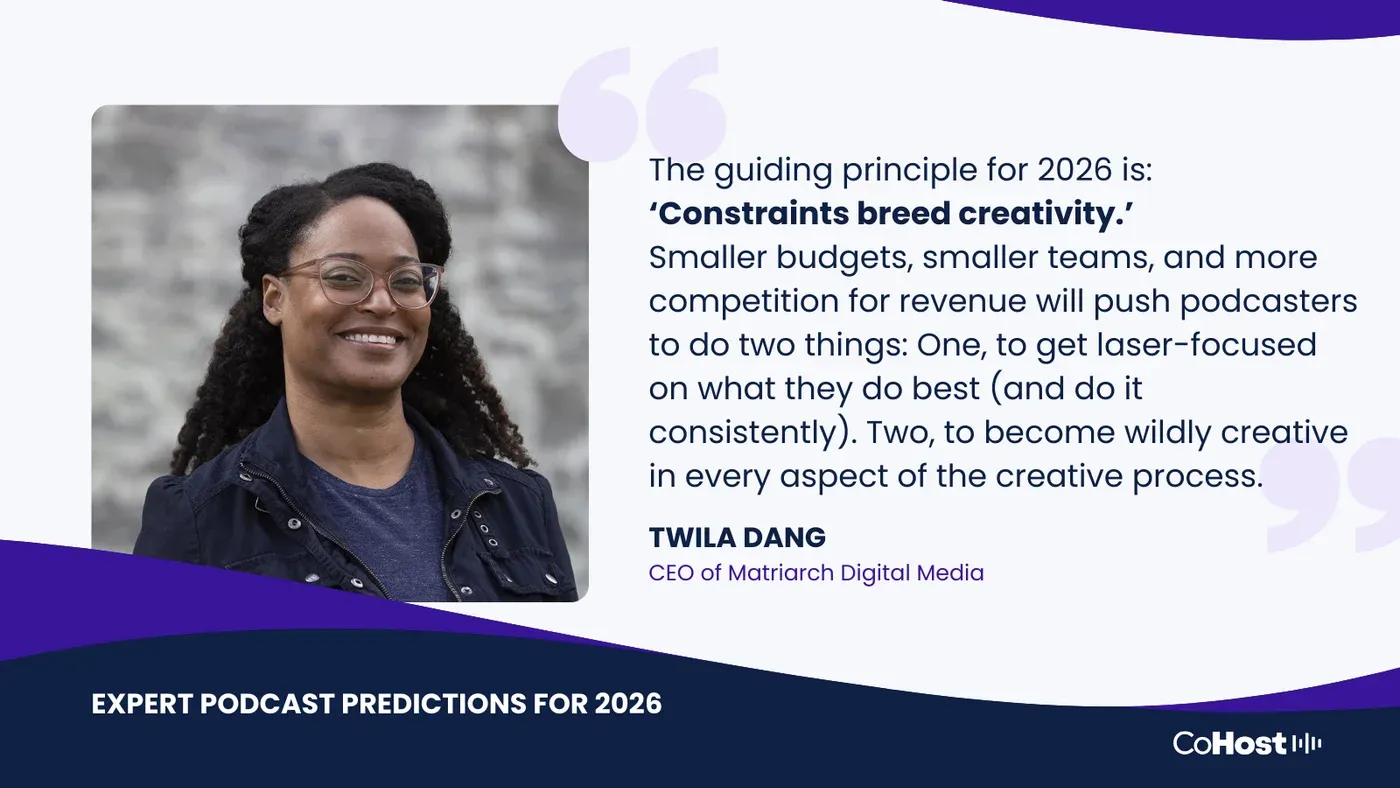
“Constraints breed creativity.”
“The guiding principle for 2026 is: ‘Constraints breed creativity.’ Smaller budgets, smaller teams, and more competition for revenue will push podcasters to do two things: One, to get laser focus on what they do best (and do it consistently). Two, to become wildly creative in every aspect of the creative process. Finding low/no-cost, collaborative, and experiential ways to finance, make, distribute, market, and grow podcast content. Those willing to embrace the chaos will change our industry for the better.”
Twila Dang, CEO, Matriarch Digital Media
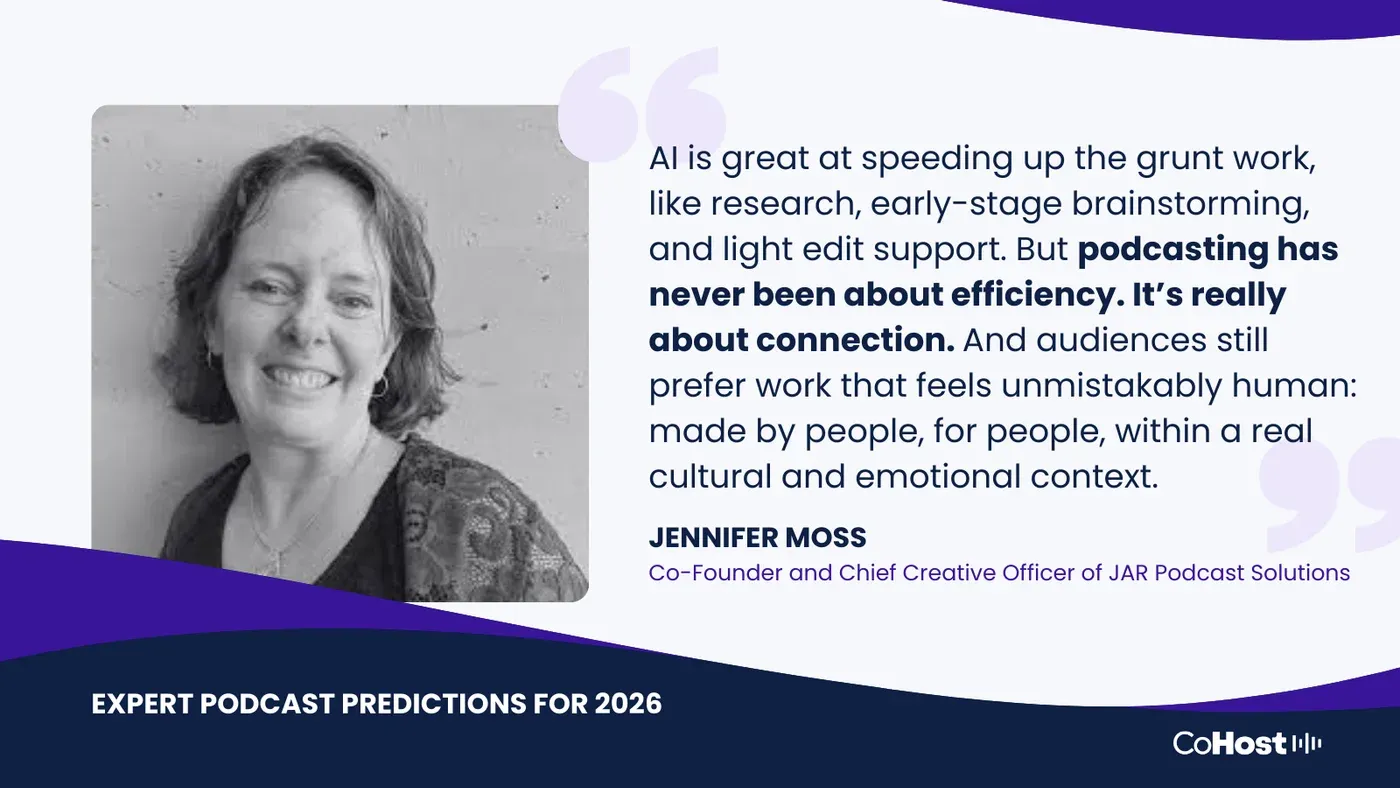
“More clarity on the role of AI and more creators adopting true multi-platform strategies.”
“1) Now that the dust is starting to settle, it’s clearer how AI will actually affect our industry. It’s great at speeding up the grunt work, like research, early-stage brainstorming, and light edit support. But podcasting has never been about efficiency. It’s really about connection. And audiences still prefer work that feels unmistakably human: made by people, for people, within a real cultural and emotional context. Most podcasters have absorbed this by now, and the “robots will replace us” panic has largely cooled.
2) We’re also going to see more creators adopting true multi-platform strategies: short social video driving to longform episodes, or clients wanting audio and video rolled out together. That convergence is here to stay, but it supplements, rather than replaces, more creative, immersive forms of audio podcasting.”
Jennifer Moss, Co-Founder and Chief Creative Officer, JAR Podcast Solutions
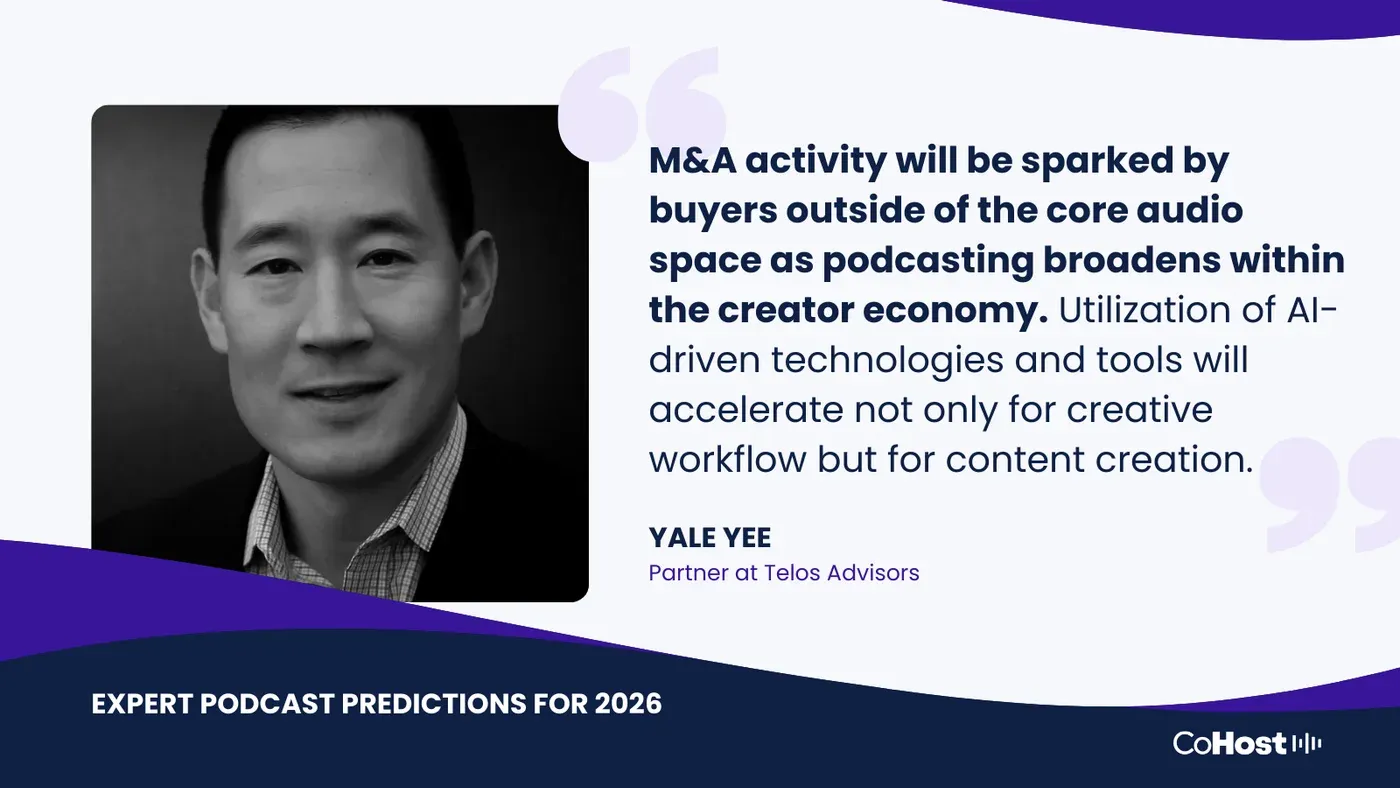
“M&A activity will be sparked by buyers outside of the core audio space.”
“M&A activity will be sparked by buyers outside of the core audio space as podcasting broadens within the creator economy. Utilization of AI-driven technologies and tools will accelerate not only for creative workflow but for content creation.”
Yale Yee, Partner, Telos Advisors
“Brands will demand clearer proof of podcast ROI.”
“In 2026, brands will demand clearer proof of podcast ROI. As measurement matures, real audience engagement will become the currency that matters, and downloads will fade as the industry’s primary benchmark.”
Jonas Woost, Co-Founder, Bumper
“We’re going to see a major split between audio-only podcasters and video podcasters.”
“We’re going to see a major split between audio-only podcasters and video podcasters. Over the last few years, the industry pushed hard toward video podcasts largely because platforms like YouTube incentivized it. But in 2026, I believe more podcasters will choose to remain audio-only, even with YouTube’s discovery power and built-in monetization.
Creators are realizing that YouTube and podcasting are fundamentally different ecosystems, each with its own algorithms, viewer/listener expectations, retention patterns, and storytelling formats.
You can’t copy and paste your podcast strategy and workflow onto YouTube and expect it to work. I predict audio podcasters unapologetically reclaiming momentum and listeners fully supporting their decision.”
Danielle Desir Corbett, Podcast Marketing Coach and host of The Thought Card Podcast
Advice for brands and creators going into 2026
“Track things like completion rate, repeat listeners, episode-to-episode loyalty, and how the show influences brand action.”
“Measure what really matters. Downloads are mainly about vanity. Track things like completion rate, repeat listeners, episode-to-episode loyalty, and how the show influences brand actions (demo requests, trust perception, time spent listening or watching).”
Jennifer Moss, Co-Founder and Chief Creative Officer, JAR Podcast Solutions
“We are a community of multi-talented creatives. Go find your people and join forces.”
“START WORKING TOGETHER! Individuals, independent companies, co-ops… we are a community of multi-talented creatives. Go find your people and join forces. We’re stronger together than scrambling solo. The next few years will be defined by how we answer the question of how to sustain and grow creative entrepreneurship in the face of tech designed to replace us. The answer will come when we stop trying to build this industry in the same vein as other media industries that prioritized growth through soulless product for profit.”
Twila Dang, CEO, Matriarch Digital Media
“Understand what you’re hoping to achieve for yourself or your organization.”
“It’s important to understand what you’re hoping to achieve for yourself or your organization, what you’re contributing to the listeners, and to have fun while doing it.“
Jeff Umbro, CEO and Founder, The Podglomerate
“Treat podcasting like every other high-performing marketing channel: lean on data.”
“My biggest advice for brands and creators in 2026 is to treat podcasting like every other high-performing marketing channel: lean on data. We’ve moved past the days of publishing episodes and hoping they resonate. Instead, brands and creators should be building their strategy around real listener behavior, look at who’s tuning in, how long they’re staying, and which topics actually keep them engaged.
Don’t just track metrics; act on them. Use consumption and retention data to refine your format, let audience insights shape your guest list and themes, and rely on tracking links to understand which promotional channels truly move listeners to action.”
Fatima Zaidi, Founder and CEO of Quill and CoHost
“Listen to your community! Stay weird!”
Steph Colbourn, CEO, editaudio
“Use AI when it can save you time on aspects of podcasting you’re not good at.”
“Use AI when it can save you time on aspects of podcasting you’re not good at. Don’t use AI to replace anything you’re amazing at. Pay attention to your unique, human differentiators and double down on them. In a world with more and more AI-generated content, more and more of the choices for audiences will become average and generic. My favourite show this year is all about AI, but 100% produced by smart, creative humans: Shell Game Season 2. More creativity, more smart concepts and formats, and more shows that get audiences talking in 2026!”
Steve Pratt, Author of Earn It! and Founder of The Creativity Business
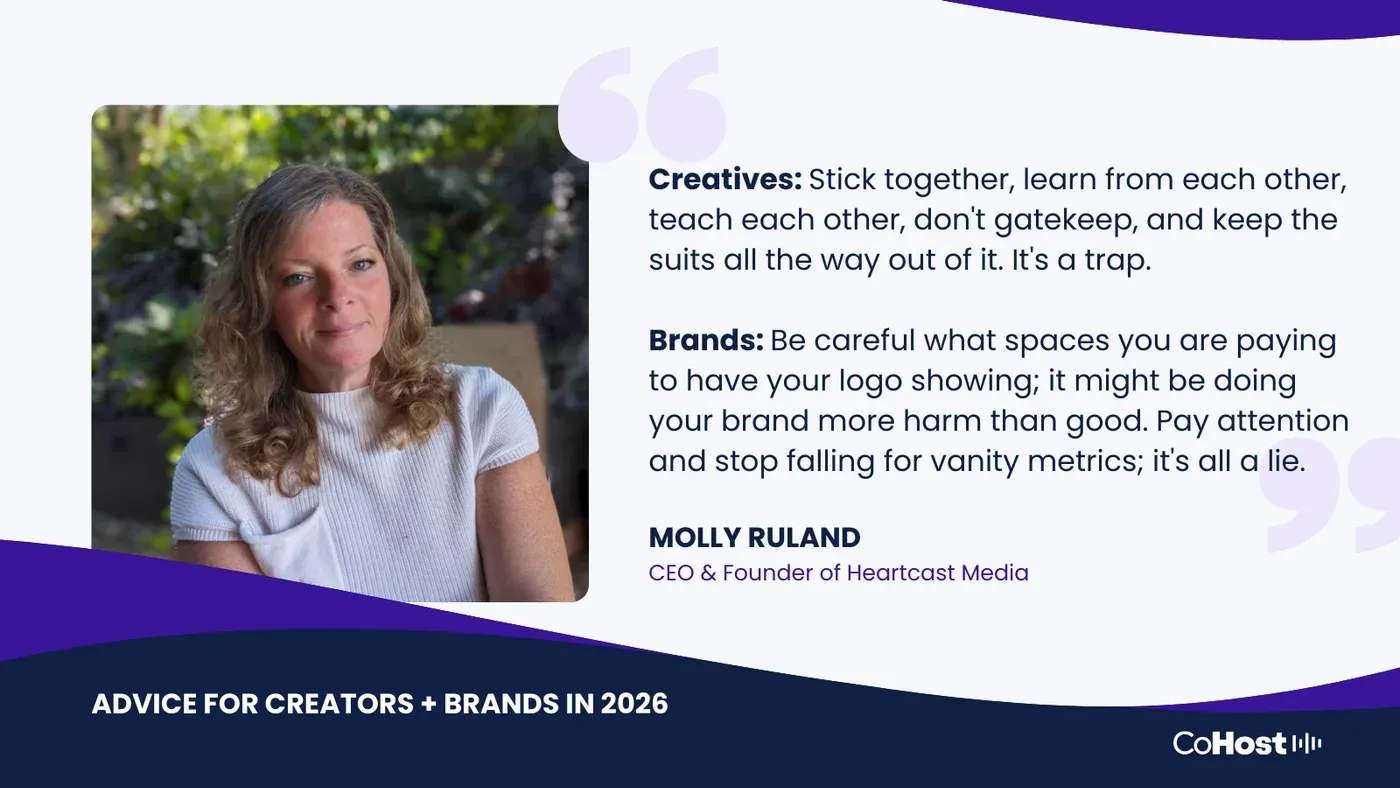
“Cratives, stick together. Brands, pay attention and stop falling for vanity metrics.”
“For Creatives: Stick together, learn from each other, teach each other, don’t gatekeep, and keep the suits all the way out of it. It’s a trap.
For Brands: Be careful what spaces you are paying to have your logo showing; it might be doing your brand more harm than good. Pay attention and stop falling for vanity metrics, it’s all a lie.”
Molly Ruland, CEO & Founder, Heartcast Media
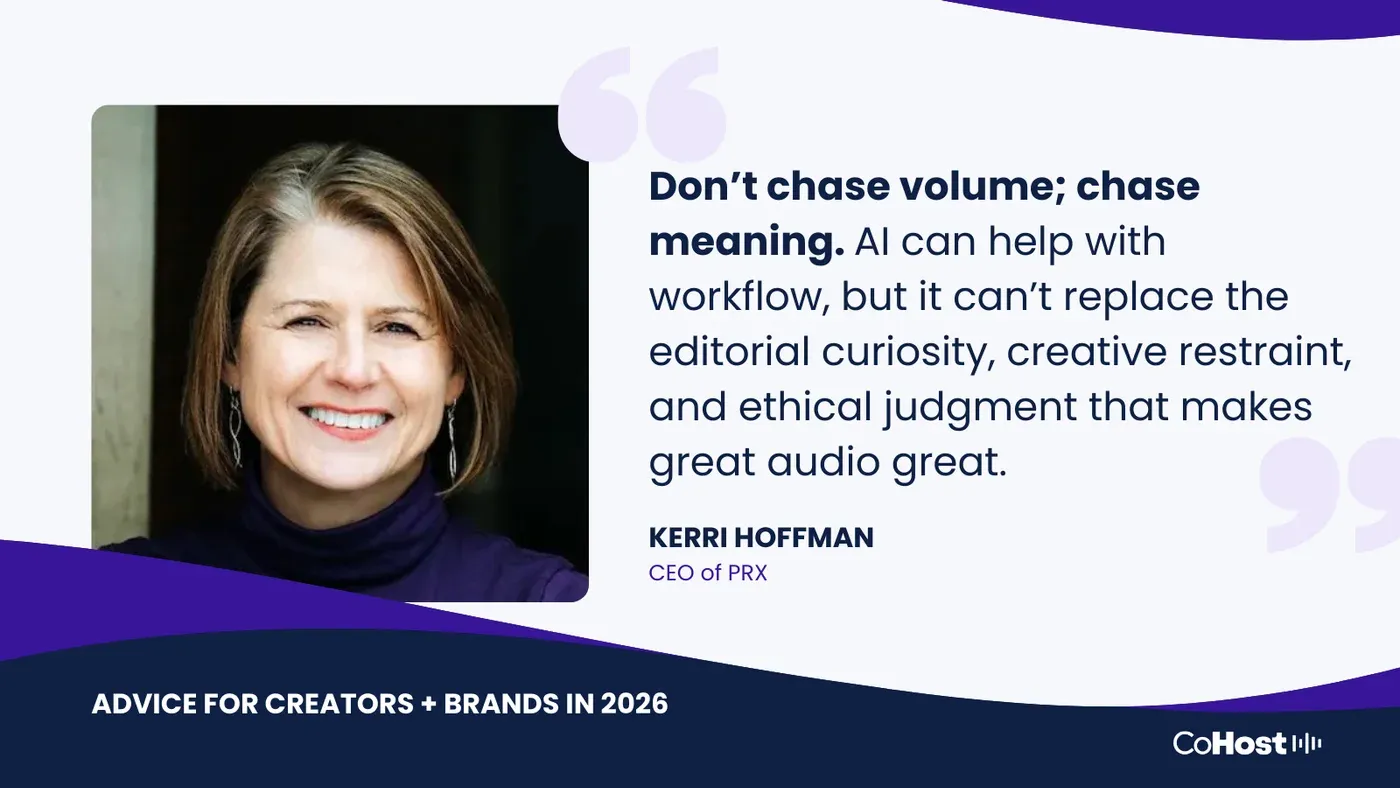
“Don’t chase volume; chase meaning.”
“Don’t chase volume; chase meaning. AI can help with workflow, but it can’t replace the editorial curiosity, creative restraint, and ethical judgment that make great audio great. Brands should partner with voices rooted in real connection. Listeners stay not because something is new, but because it feels meaningful to them. Longevity comes from reliability, show up for your listeners, and they will show up for you.”
Kerri Hoffman, CEO, PRX
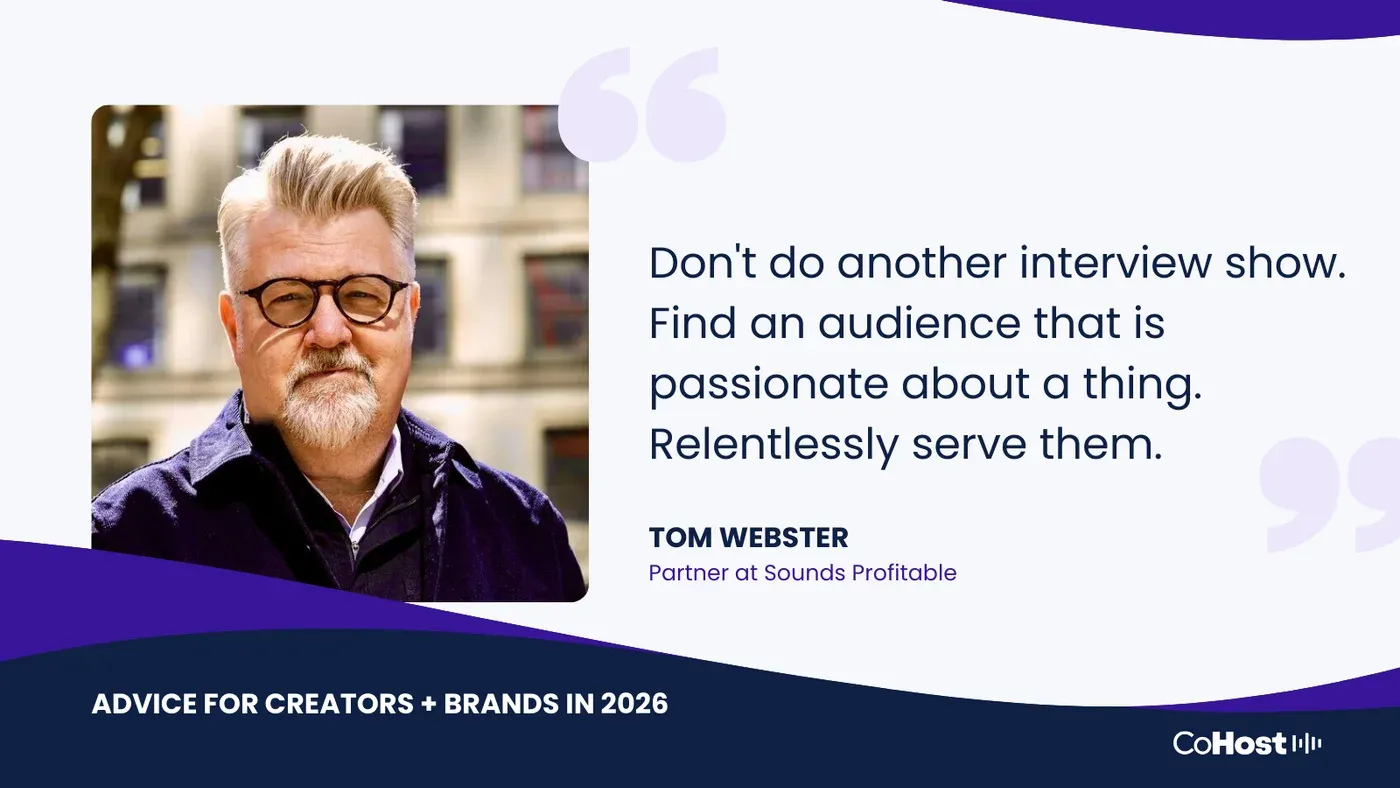
“Find an audience that is passionate about a thing. Relentlessly serve them.”
“Don’t do another interview show. Find an audience that is passionate about a thing. Relentlessly serve them.”
Tom Webster, Partner, Sounds Profitable
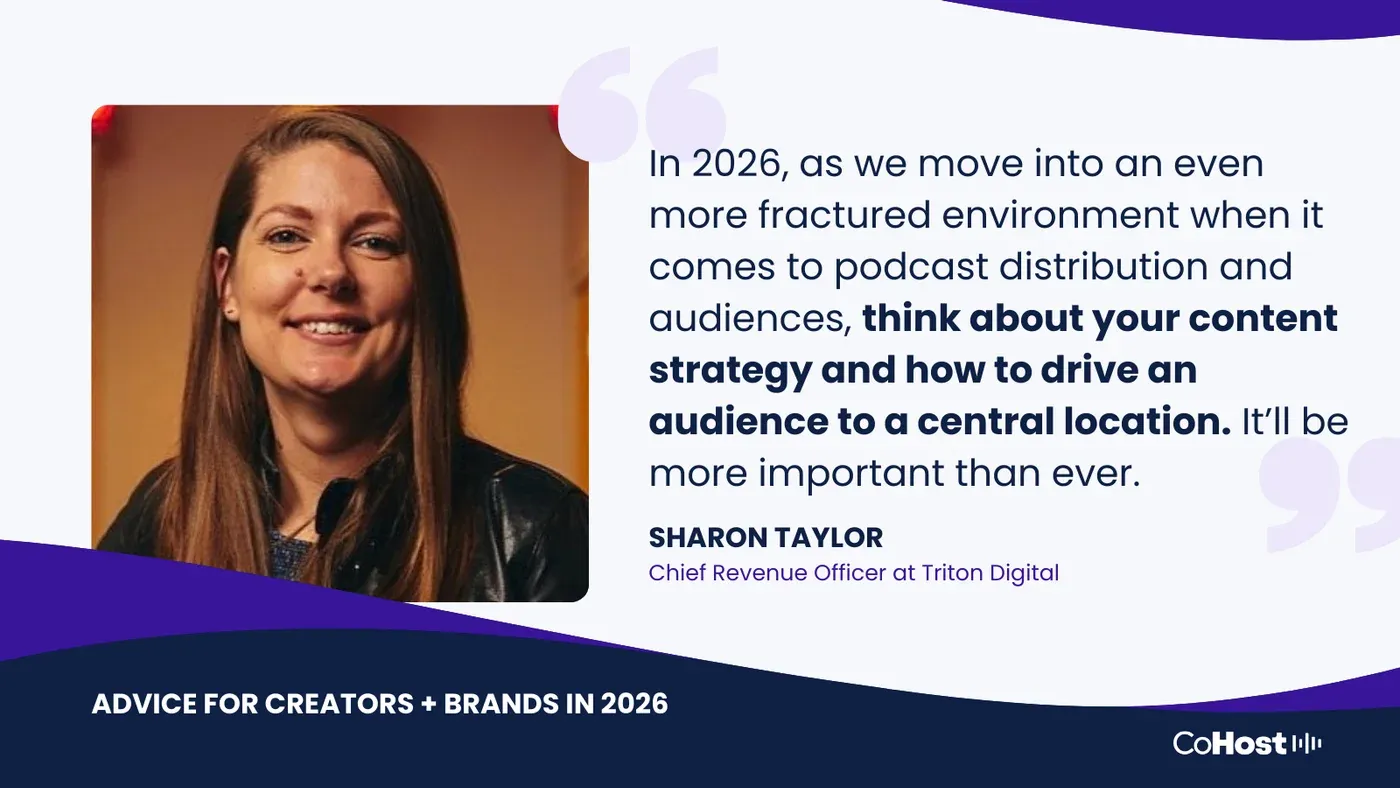
“Think about your content strategy and how to drive an audience to a central location.”
“Content consumption is increasingly modular, and podcasts are available in more locations than ever before. Historically, in the hunt for an audience, creators have taken the approach of putting full episodes in as many places as possible - even if that means distributing outside of RSS. In 2026, as we move into an even more fractured environment when it comes to podcast distribution and audiences, think about your content strategy and how to drive an audience to a central location. It’ll be more important than ever.“
Sharon Taylor, Chief Revenue Officer, Triton Digital
“For creators, embrace 360 monetization and find partners that can help you maximize value.”
Yale Yee, Partner, Telos Advisors
“Don’t overlook Pinterest as a distribution channel, it’s an underutilized platform for podcast discovery that could deliver surprising results.”
Marie Shehadi, Creator Success Lead, HubSpot Media Creators Network
Looking ahead to 2026
The experts agreed on one thing above all: podcasting is maturing. Measurement is sharpening, creators are doubling down on human connection, and audiences are becoming more discerning than ever.
Brands that prioritize purpose over volume, creators who build trust over time, and teams that embrace both creativity and data will be the ones who cut through the noise.No matter what platforms shift, what tools emerge, or how algorithms behave, one truth stays constant: people show up for stories that feel genuine, useful, and intentionally made.
To stay up to date with the latest in podcasting, subscribe to our bi-weekly newsletter, Tuned In.
