

Many branded podcasts fail.
Not because the audio is bad.
Not because the hosts lack charisma.
Not because the topics aren't interesting.
They fail because nobody decided what the podcast was actually for before the first episode dropped.
And no, this isn't another "find your niche and post consistently" post. After working with hundreds of brands building podcasts (B2B SaaS, professional services, FinTech, healthcare, consumer giants, and the agencies producing shows for all of them), there's a clear pattern between the podcasts that turn into pipeline drivers and the ones that turn into expensive vanity projects.
The difference isn't audio gear or talent. It's the strategy behind the podcast itself.
This is the playbook for building a branded podcast strategy that delivers business outcomes in 2026. Not just downloads on a dashboard your leadership doesn't trust... or care about.
TL;DR: The branded podcast strategy cheat sheet
A branded podcast strategy is the documented plan for:
- Why your brand is producing a podcast
- Who the podcast is for
- What you'll cover
- How you'll measure success
- How the show fits into your broader marketing mix
Strategies that survive in 2026 share five traits:
- A specific business goal: Not "brand awareness" as a black box. A measurable outcome.
- A narrowly defined listener: By job role, seniority, company size, and industry. Not "professionals."
- A sustainable format: Something you and your team can confidently execute for at least 12 months without burnout.
- Measurement that goes beyond downloads: Listener firmographics, audience demographics, CRM/pipeline influence, and other key podcast analytics that we'll cover.
- An audience growth and marketing plan: Distribution, promotion, and paid amplification, built before launch, not after.
The podcast strategies that collapse share a common trait: They were never created before the team pressed record.
Let's make sure you're not one of those teams.
What is a branded podcast strategy?
A branded podcast strategy is a documented plan that defines the business purpose, target listener, content focus, production format, audience growth and marketing approach, KPIs, and measurement framework for a podcast produced by a brand.
Think of it as the business case for the show. It answers the four questions your leadership will ask within six months of launch:
- Who is this for?
- What is it producing for the business?
- How are we measuring it?
- Why does it cost what it costs?
If your current strategy can't confidently answer those, the show is on a countdown clock.
Why some branded podcast strategies don't survive
Let me set the scene.
A marketing team gets approval for a podcast, hires a host, books four guests, launches, watches downloads slowly climb, and then, somewhere between episode 8 and 14, leadership asks, "So, is this working?" and nobody has a clean answer.
Then the show goes on pause. Which is most likely the polite way of saying it's dead.
As I mentioned, the cause of this outcome is rarely bad execution. The cause is that the strategy was never robust enough to survive the inevitable questions:
- What does "working" even mean?
- Compared to which benchmark?
- Tracked against what business outcome?
So, what do you need to answer before you start getting the above questions from leadership? These are the top three:
- Who is this show for? Not "marketers." A specific role, seniority, company type, etc.
- What outcome does the show drive? Not "awareness." A measurable business result like pipeline growth or engagement, ABM opportunity identification, or partnership building.
- How will we know it's working? Not "we'll grow downloads by X%." A specific signal, like the number of accounts engaged or consumption rate amongst target audiences.
No, answering these questions isn't necessarily the fun part of branded podcast creation, but that doesn't mean they're not critical.
The 7-part branded podcast strategy framework
This is the framework we walk marketing teams through. It's the same shape regardless of whether you're a 50-person FinTech brand launching your first podcast or a Fortune 500 enterprise relaunching one that stalled.
The seven-part branded podcast strategy framework:
- Define the (specific) business goal
- Identify the listener at the persona level
- Audit the category and find the gap
- Pick the format based on what your team can sustain
- Build the content engine
- Engineer the audience growth plan
- Decide what success looks like and how to measure it
1. Define the (specific) business goal
The first move in any branded podcast strategy is committing to a primary business goal. Not three. One.
Listen, branded podcasts can drive multiple outcomes, but you should only optimize for one at a time. Trying to optimize for brand awareness, lead generation, and customer education simultaneously is how you end up with a podcast that does none of them well.
The four most common branded podcast goals:

Pick one and get comfy with it. A podcast designed for pipeline influence looks completely different from one designed for category leadership. Different guests, different formats, different metrics, different team involvement.
If leadership pushes back on picking just one, the conversation to have looks something like: "We can serve a secondary goal as a side effect, but we can't optimize for two primary goals simultaneously."
2. Identify the listener at the persona level
This is where most branded podcast strategies get way vague and never recover.
"Marketers" is not an audience. "Mid-market B2B professionals" is not an audience. "Decision-makers" is, somehow, even worse.
A useful audience definition for a branded podcast includes at least:
- Job role and seniority (e.g., VP of Demand Gen, Senior Director of Marketing, Senior Manager of Marketing Operations)
- Company size (e.g., 200–500 employees)
- Industry (e.g., B2B SaaS, FinTech, professional services, EdTech)
- Buying context (e.g., currently evaluating ABM tools, running an outbound motion, building a partnership program)
The narrower this gets, the better the show performs. A B2B podcast with 400 listeners who are Heads of Marketing at target accounts is worth substantially more than one pulling 40,000 downloads from unidentifiable listeners who will never buy.
But here's the part most teams don't always realize.
Once your show is live, you can actually validate this. Listener firmographics (company names, industries, employee size, job roles tuning in) are now available for branded podcasts. So the "who is actually listening?" question stops being a guess and starts being a dashboard.
CoHost's B2B Analytics reveals the companies, job roles, and seniority levels that engage with your podcast. This allows marketers to validate ICP fit, surface target accounts already listening, and feed those insights to sales teams.
3. Audit the category and find the gap
I've seen plenty of branded podcast strategies skip the category audit because it feels redundant. "We know our space; we don't need to listen to competitor podcasts." Sorry to say, but this is almost always wrong.
A 90-minute audit of the top 10–15 podcasts in your category will tell you:
- What topics are oversaturated? If every podcast in your category has done a "future of AI" episode, yours probably shouldn't be next.
- What formats dominate? Interview shows? Solo monologues? Roundtables?
- What guests are recycled? Do the same 50 names show up across 80% of podcasts in your category?
- What is the actual content gap? What are the topics nobody's covering well, perspectives nobody's bringing, or the audience segments nobody's serving?
This type of podcast audit is going to tell you how to be the first, the best, or different from other shows in your category. The output from this exercise can be as simple as a one-liner in your strategy, like: "The gap in our category is X, our show fills it by doing Y, and the angle no one else is taking is Z."
CoHost Tip: Use AI to your advantage here. I've used Claude Code many times to build the base of category research reports.
4. Pick the format based on what your team can sustain
Format selection in a branded podcast strategy is part editorial decision, part resource math. Sorry to bring math into this.

Pick the format your team can sustain for at least 6-12 months. Not the format you find most exciting in week one.
I like to roughly do a sustainability check. Calculate the total hours per episode (recording + editing + scheduling + promotion + analytics review), multiply by your target cadence. If the result exceeds 20% of any team member's time, you need a different format, a smaller cadence, or a production partner (check out our parent branded podcast agency, Quill 👀)
5. Build the content engine
A branded podcast strategy doesn't ship without a content engine. This is a system for generating episode ideas, sourcing guests, and producing episodes on a predictable schedule.
A working content engine includes:
- Topic pillars: Three to five pillars that all episodes ladder up to. Without pillars, every episode becomes a one-off, and the show loses coherence. This is likely something you're already doing with blogs, reports, webinars, etc.
- A guest pipeline (if interview format): A rolling list of 15+ potential guests, ranked by audience fit and outreach status. Not "people we'd love to talk to someday." A real CRM-style pipeline that's achievable.
- A production calendar: Recording, editing, publishing, and promotion dates locked at least 6 weeks ahead. I've seen many podcasts go awry, miss episode drops, or fall off the wagon because the production calendar lives in one individual's head, or you don't plan ahead.
- A content repurposing plan: Each episode generates blog content, social clips, email content, and sales enablement material. Figure out your content flow before launch, not after. What teams do you need to send the episode to? What assets do you need to create?
6. Engineer the audience growth plan
A podcast without a marketing plan is just an audio file your team spends a lot of time producing. Most branded podcasts launch and assume the audience will figure itself out. Maybe they'll throw a LinkedIn post out about it, but that's really it. And you can probably guess this, but that assumption is wrong.
If I were to tell you to create a branded podcast marketing plan, I'd have you cover these four layers:
Layer 1: Distribution (where the show lives)
Apple Podcasts, Spotify, Amazon Music, YouTube, iHeart, Pocket Casts, Overcast, and many more. Most podcast hosts handle this distribution automatically, especially for audio-only shows. But still, confirm your podcast is going live everywhere that ingests an RSS feed. If you publish a video version of the show, you'll either want a host that publishes directly to YouTube, Apple Podcasts, and Spotify, or you'll have to do it manually.
Layer 2: Owned channel promotion
Your website (with a podcast page built to convert visitors into subscribers), email list, social media accounts, sales team, customer success team, and existing customer base. Owned channels are likely where the first 100 listeners come from, and even better... they're free.
Layer 3: Earned amplification
Guest swaps with adjacent shows, cross-promotion with hosts in your category, mentions in industry newsletters, inclusion in "best podcasts for X" roundups, and PR around big guests or major episode drops. Slow to compound, but the listeners you get from earned channels tend to be high quality.
Layer 4: Paid audience growth
Paid is growing into a core piece of many branded podcast marketing plans, especially if you're trying to reach a specific B2B audience at scale. Paid podcast ad campaigns running on other shows in your category, listening app banner takeovers, LinkedIn promotion of episode clips, retargeting visitors who hit your podcast page, and targeted social promotion of your highest-performing episodes.
Paid is the lever I see many brands underutilize, and that's often because they assume podcast growth is purely organic. Of course, some podcast growth is, but I've seen paid work incredibly well for not just driving target audiences to a show, but also retaining them.
If running paid audience growth in-house isn't realistic for your team (time constraints, industry knowledge, etc.), that's exactly what PodPromote, our paid audience growth service, exists for. It runs targeted podcast ad campaigns for branded podcasters across major podcast networks and listening apps, with the same ICP-led targeting logic we apply to measurement.
This shouldn't come as a surprise to you, but having a plan in place covering how you'll promote and grow the podcast amongst your target audience is so critical. Yet, I do see plenty of brands put all their time and effort into just the creation of the show itself (which is good, great content is a huge piece of this), but then drop the ball on audience growth.
You need to balance both podcast production and podcast marketing to build a well-rounded branded podcast.
CoHost Tip: Check out CoHost's New Listener Metric to measure how many new listeners your marketing efforts are bringing in. Spot trends in listener growth following new promotional campaigns.
7. Decide what success looks like and how to measure it
This is the part of a branded podcast strategy that determines whether the show survives its first leadership review.
And I'll start by saying downloads are not your north star metric. Yes, they're an additional data point to add to reports, showing overall reach and awareness. But... that's all they are. In 2026, better metrics are available for your brand's podcast, so the conversation needs to be about what's actually proving the show works.
The metrics that hold up in front of leadership:
For pipeline influence goals:
- ICP match rate: Track the percentage of listener companies matching your ideal customer profile through your podcast's B2B Analytics, which surfaces listener company names and other firmographic data.
- Target account presence: Cross-reference your target account list against the company names appearing in your audience firmographics on a monthly or quarterly basis.
- Pipeline influence: Connect listener company data to your CRM to see which listener companies become opportunities, accelerate deal velocity, or close. Check out CoHost's Salesforce Integration.
For demand gen goals:
- Audience composition: Track via your podcast's audience analytics dashboard, segmenting listeners by job title and seniority to confirm you're reaching decision-makers, not interns.
- Lead capture from podcast assets: Measure form fills from your podcast page, episode-specific landing pages, and any gated bonus content (transcripts, episode guides, related reports). Many teams will already have marketing automation tools in place, but if not, GA4 will get the job done.
- Pipeline influence: Same as the pipeline influence goal, connect listener company data to your CRM to see which listener companies become opportunities.
For customer marketing goals:
- Listener-customer overlap: Match the listener company names from your audience analytics (B2B Analytics) against your active customer list to see how many existing customers are actually tuning in.
- Customer engagement signals: Layer podcast exposure into your customer health scoring, then track NPS movement and expansion conversations among customers who engage with the show.
- Renewal rate of exposed customers: Compare retention rates between customers exposed to the podcast and those who aren't, tracked through your CRM and customer success platform.
For category leadership goals:
- Inbound media mentions: Track press inclusion, podcast roundup features, and earned mentions through media monitoring tools or a manual quarterly review of branded search and category coverage.
- Speaking invitations and industry recognition: Log inbound speaking requests, award nominations, and panel invitations triggered by podcast visibility in a shared spreadsheet or CRM record so you can attribute them back to specific episodes or guests.
- Share of voice within your category: Measure your podcast's relative visibility versus competitor shows using social listening tools, chart rankings on Apple Podcasts and Spotify, and any category-specific industry rankings.
Once you've collected your podcast's performance data, put every report through the "so what?" test before sharing it with leadership. Don't worry, the test is simple. State the report insight, then ask yourself, "So what?" and see whether your answer connects to a business outcome leadership actually cares about.
If the best answer is "we got in front of more people" or "we drove more traffic," the report insight likely failed the test (of course, depending on your goals), and you need to change the data you're tracking.
Here's what passing and failing look like side by side:
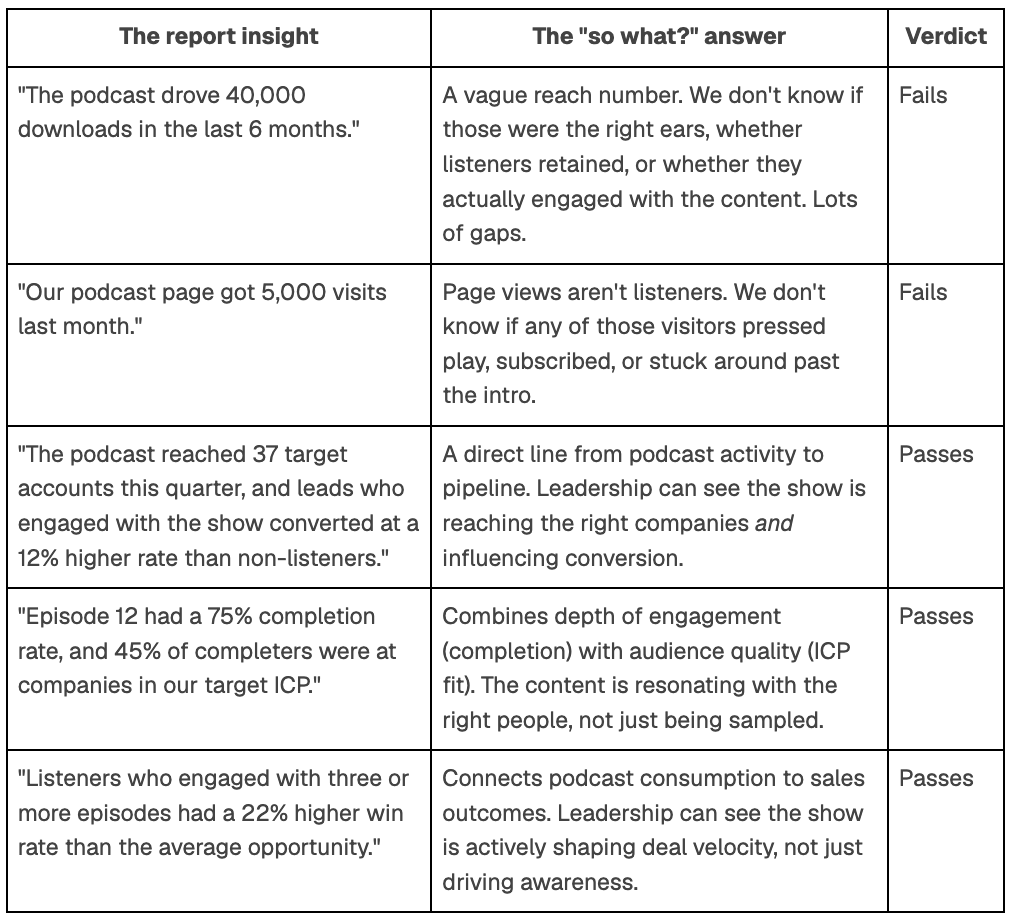
The pattern here is clear. Report insights that pass connect podcast activity to a business question leadership is actually asking: Pipeline, conversion, target accounts, retention. Reports that fail describe activity and call it a result.
I can't say this enough: the dashboard you build to measure the success of your brand's podcast should be the one that produces reports leadership actually wants to read. This is what keeps your podcast budget intact next year.
Branded podcast strategy mistakes to avoid
After watching strategies break in similar ways across hundreds of brands, here are the negative patterns worth naming.
- Optimizing for downloads: I have said it before, and I shall say it again, downloads are a vanity metric for brands. They are never, by themselves, a business metric. If your report leads with download counts, your strategy needs an upgrade.
- Picking a host before picking a goal: The host should serve the goal, not the other way around. "Our CEO wants to host" is a constraint, not a strategy. Sometimes, an employee thought leader or outside creator is the best person for the job (goal dependent).
- Launching without a measurement plan: If you can't articulate how you'll know the show is working before episode one, you won't be able to articulate it at episode 12 either. Get your foundation built correctly from the start (and if you're already years into your brand's podcast... there's no time like the present). Make sure you have the right podcast analytics tools and workflows in place to effectively measure podcast performance.
- Treating the podcast as a side project: Branded podcasts that succeed are funded, staffed, and treated as a primary marketing program. The ones pushed onto someone's plate as a 10% project produce 10% results.
- Underestimating how long this takes: Branded podcasts compound. The first six months can be slow; I'm not going to sugarcoat it. But it's the brands that bridge consistency and quality that see the line start to curve upward.
Branded podcast strategy FAQ
What is a branded podcast strategy?
A branded podcast strategy is the documented plan that defines why your brand is producing a podcast, who it's for, what it'll cover, what format it'll take, how it'll be distributed, and how you'll measure success. It's the business case for the show, not the content calendar.
What's the difference between a branded podcast and a regular podcast?
A branded podcast is produced by a brand (a company, agency, or organization) as part of its marketing or communications mix. A regular podcast is produced by an independent creator or media company. The difference matters because branded podcasts have specific business goals (pipeline, awareness, retention) that independent podcasts don't share. And they need to be measured against those goals.
How do you measure the ROI of a branded podcast?
The metric depends on the goal. For pipeline-driven branded podcasts, measure ICP match rate (what percentage of listener companies match your ideal customer profile), target account presence in the audience, and influenced pipeline through CRM matching. For awareness-driven podcasts, measure audience composition by role and seniority, brand lift, and earned media. And no, downloads alone are not a measurement of podcast ROI.
What's the budget for a branded podcast?
Production costs range from roughly $500/episode for a lean DIY setup to $5,000+/episode for fully produced, video-included branded podcasts with editing, distribution, and amplification support. Podcast hosting platforms range from around $20/month for basic plans to $500+/month for enterprise plans with full analytics, integrations, and white-glove migration. I will caveat that for brands in particular, spend your time researching the pros and cons of different hosting platforms and analytics tools; most are built for independent creators looking to monetize, not brands. A good place to start is, of course, CoHost 😉.
Do branded podcasts work for B2B?
Yes! Podcasts can be such a powerful tool for B2B brands. Take a look at impact.com, Procore, and Russell Reynolds Associates. The brands that succeed treat branded podcasts as account-based marketing channels rather than mass-reach channels. A B2B branded podcast with 500 downloads per episode, reaching Heads of Marketing at target accounts, is worth substantially more than one pulling 10,000 downloads from a general, unmeasurable audience.
Putting your branded podcast strategy to work
If you're launching a new branded podcast, the strategy framework above gives you something you can sign off on with leadership before you spend a dollar on production.
If you're relaunching an existing show or just trying to improve an active one, the same framework will surface exactly which part of the strategy broke or needs some attention. Usually, it's the measurement layer; sometimes, it's the listener definition; occasionally, it's the format. Rarely is it the content itself.
The bar in branded podcasting is still surprisingly low. Most shows in any given category are interchangeable. That's your opening right there. And the brands that treat strategy seriously are the ones who'll still be publishing (and growing pipeline) twelve months from now.
The branded podcasts that don't will be put on pause.
Ready to build (or rebuild) your branded podcast strategy?
Book a demo to see how CoHost helps B2B brands measure who's actually listening (by company, job role, seniority, and industry) and connect that data directly to your CRM. Or explore CoHost pricing to see which plan fits your team and your stage.
Or want to stay updated on the branded podcast landscape, tips for marketers, audience trends, and measurement tactics? Subscribe to Tuned In, the bi-weekly newsletter for marketers creating branded podcasts.